---
title: MiniCPM-OCR-Jev
canonical_url: "https://www.modelscope.ai/models/OpenBMB/MiniCPM-OCR-Jev"
md_url: "https://www.modelscope.ai/models/OpenBMB/MiniCPM-OCR-Jev.md"
repository: OpenBMB/MiniCPM-OCR-Jev
last_updated: 2026-11-03
license: apache-2.0
pipeline_tag: image-text-to-text
tasks:
  - image-text-to-text
model_type:
  - qwen3_5
architectures:
  - Qwen3_5ForConditionalGeneration
base_model:
  - Qwen/Qwen3.5-2B
base_model_relation: finetune
parameters: 2.2B
tensor_type:
  - BF16
library_name:
  - safetensors
  - pytorch
frameworks:
  - pytorch
language:
  - en
  - zh
downloads: 30
stars: 0
tags:
  - minicpm-ocr
  - ocr
  - correctness-decision
  - ocr-verification
  - multimodal
  - vision-language
  - jev
---

# MiniCPM-OCR-Jev

> MiniCPM-OCR-Jev - An open-source model by OpenBMB on ModelScope. GitHub · Free API · Usage · Skill

OpenBMB/MiniCPM-OCR-Jev is a 2.2B-parameter image-text-to-text model on ModelScope. licensed under apache-2.0. derived from Qwen/Qwen3.5-2B.

- **Repository**: OpenBMB/MiniCPM-OCR-Jev
- **License**: apache-2.0
- **Tasks**: image-text-to-text
- **Parameters**: 2.2B
- **Base model**: Qwen/Qwen3.5-2B
- **Tags**: minicpm-ocr, ocr, correctness-decision, ocr-verification, multimodal, vision-language, jev
- **Downloads**: 30
- **Stars**: 0
- **Last updated**: 2026-11-03

Source: https://www.modelscope.ai/models/OpenBMB/MiniCPM-OCR-Jev

---

<div align="center">

<p align="center">
  <a href="https://github.com/OpenBMB/MiniCPM"><img src="https://raw.githubusercontent.com/OpenBMB/MiniCPM-OCR/main/assets/minicpm-ocr/minicpm-logo.jpg" width="300" alt="MiniCPM logo"></a>
</p>

[GitHub](https://github.com/OpenBMB/MiniCPM-OCR) · [Free API](https://platform.modelbest.ai/console/docs/api/ocr-jev) · [Usage](https://github.com/OpenBMB/MiniCPM-OCR#using-minicpm-ocr) · [Skill](https://github.com/OpenBMB/MiniCPM-OCR#skill)

</div>

**MiniCPM-OCR Jev** is a **2B OCR correctness decision model** for text, formula, and table
regions. Given a region image and a candidate OCR result, it returns a **score from 0 to 1** —
higher means the candidate is more likely correct. Use it to auto-accept reliable regions,
route the rest to human review, or pick the best result among several OCR models.

- 🛡️ **A small model that beats larger ones**: at only 2B parameters, decision AUROC (×100) on
  [JevOCRBench](https://huggingface.co/datasets/openbmb/JevOCRBench) is **93.6**, above
  JEV-35B-A3B (90.1) and close to Qwen3.5-397B-A17B (93.8).
- 🧩 **Stable generalization**: on parses from MiniCPM-OCR 1.0, GLM-OCR, PaddleOCR-VL-1.6, and
  Xiaomi-OCR-0, AUROC (×100) stays in **91.9–93.4**.

### Architecture

Trained from **Qwen3.5-2B**. The vision encoder and language backbone are retained, and the
language-model output head `lm_head` is replaced with a **binary classification head** that
learns whether a candidate is correct.

#### Inputs and outputs

| Item | Description |
| :--- | :--- |
| Assessment unit | One text / formula / table region plus its candidate OCR result |
| Original region image | The crop from the document |
| Candidate content | OCR text and an image rendered from that text |
| Output | Score in 0–1; higher = more likely correct |

Internally, the model uses a matched original region image, candidate text, and rendered
image. When calling the cloud API, the Docker image, or the SDK service with a built-in
renderer, provide the original region image, candidate text, and the correct region category
(text, formula, or table); the service handles rendering. The SDK service without a renderer
requires the caller to supply the rendered image. See the [deployment guide](https://github.com/OpenBMB/MiniCPM-OCR/blob/main/docs/minicpm_ocr_jev_tutorial_en.md) for request fields
and image encoding formats.

### Evaluation Results

The table below reports overall and per-category AUROC (×100) on JevOCRBench. Higher values
indicate better discrimination between correct and incorrect parsing results.
<p align="center"><img src="https://raw.githubusercontent.com/OpenBMB/MiniCPM-OCR/main/assets/minicpm-ocr/jev-benchmark-score-table.png" alt="Overall, text, formula, and table AUROC on JevOCRBench, highlighting MiniCPM-OCR Jev." width="100%"></p>

### Discrimination across OCR models

The cross-parser experiment uses the same 200 samples randomly drawn from JevOCRBench. Four
OCR models parse the samples independently; each result is manually labelled correct or
incorrect and then scored by MiniCPM-OCR Jev.

| OCR model | MiniCPM-OCR 1.0 | GLM-OCR | PaddleOCR-VL-1.6 | Xiaomi-OCR-0 |
| :--- | ---: | ---: | ---: | ---: |
| AUROC (×100) | 92.7 | 91.9 | 93.4 | 93.1 |

In this experiment, AUROC (×100) ranges from 91.9 to 93.4, with a maximum difference of 1.5
points. These results describe performance on the samples and parser combinations above.
Validate separately on your target data when using other parsers or new document types.

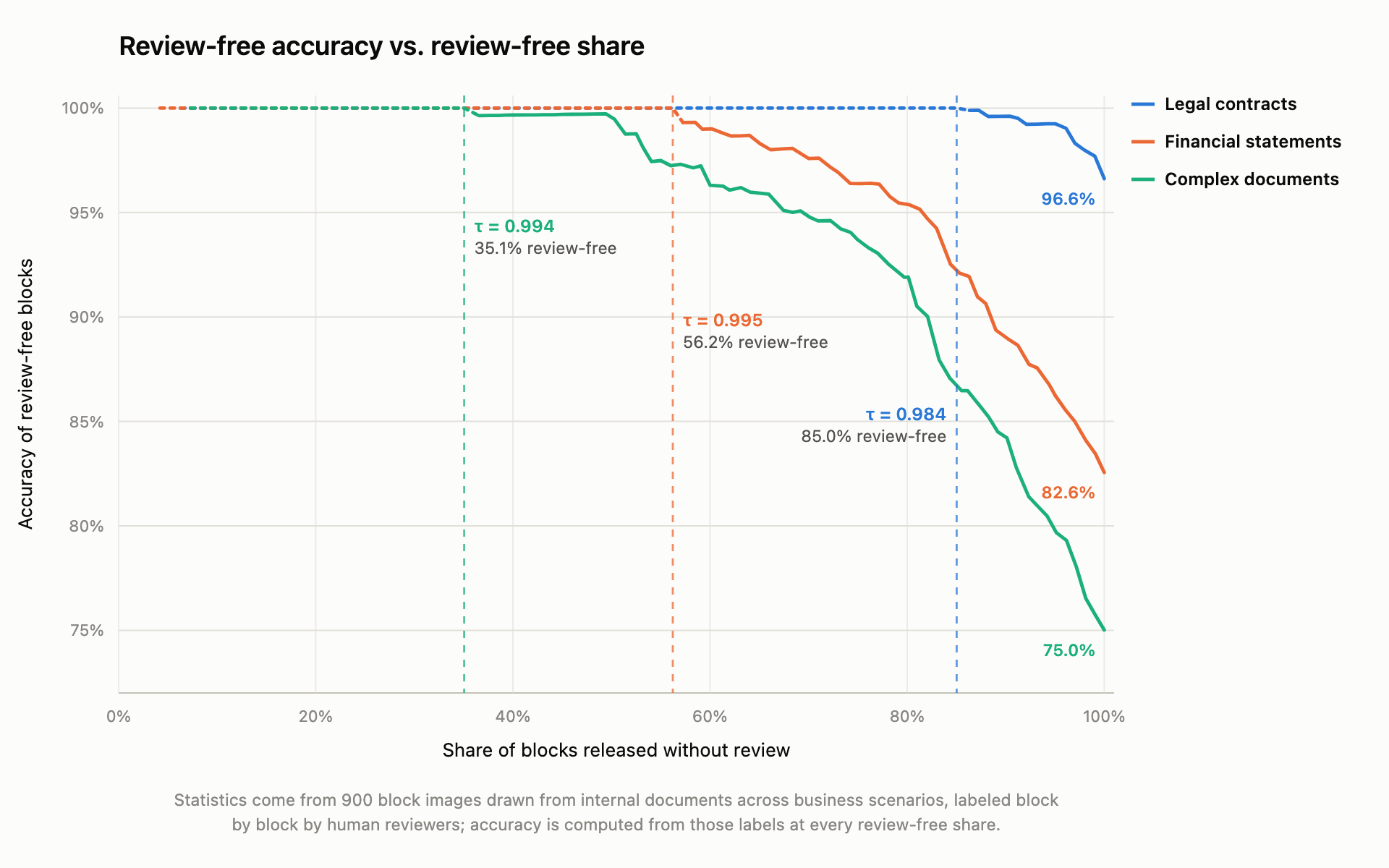
### Automatic screening to reduce human review

Score the parsed result for each region and choose a threshold using samples from your
application. Results above the threshold proceed automatically; the rest go to human review.
A higher threshold typically reduces the number of results that pass automatically, so monitor
both the accuracy of automatically accepted results and the volume of human review.

<p align="center"><img src="https://raw.githubusercontent.com/OpenBMB/MiniCPM-OCR/main/assets/minicpm-ocr/review-free-en.png" alt="Accuracy versus review-free rate for legal documents, financial receipts, and complex documents." width="100%"></p>

### Selecting across models to improve parsing quality

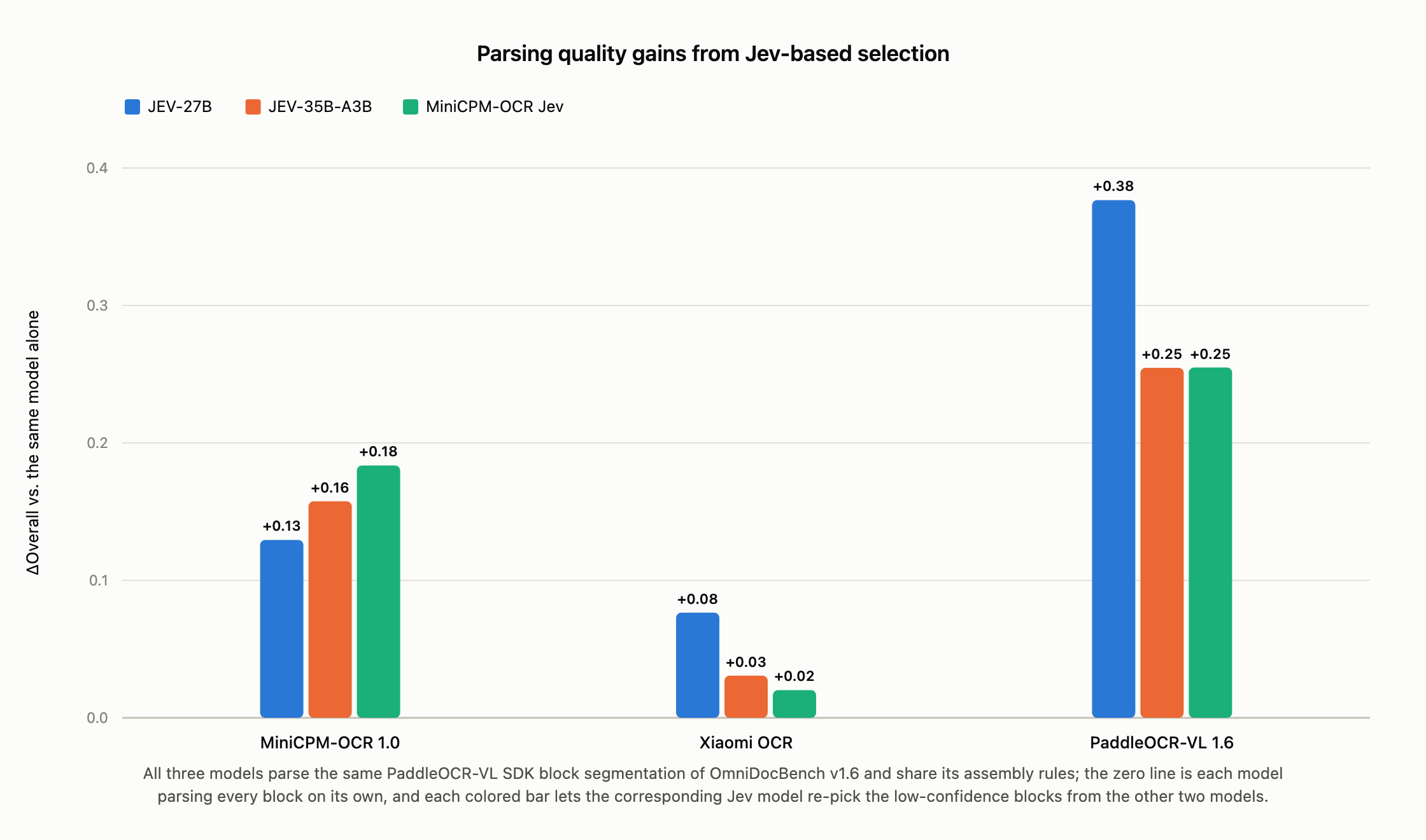
Use the same layout segmentation to have several OCR models parse each region. MiniCPM-OCR Jev
scores the candidates for the same region, selects the highest-scoring candidate, and combines
the selected results in reading order. If all candidates fall below the application threshold,
the region can still be sent for human review.

<p align="center"><img src="https://raw.githubusercontent.com/OpenBMB/MiniCPM-OCR/main/assets/minicpm-ocr/multi-models-improvements-en.png" alt="Parsing-quality gains from MiniCPM-OCR Jev scoring for MiniCPM-OCR 1.0, Xiaomi OCR, and PaddleOCR-VL 1.6." width="100%"></p>

Candidates for the same region must share the crop and content boundaries. Jev selects among
existing candidates, so quality is bounded by their coverage and correctness.

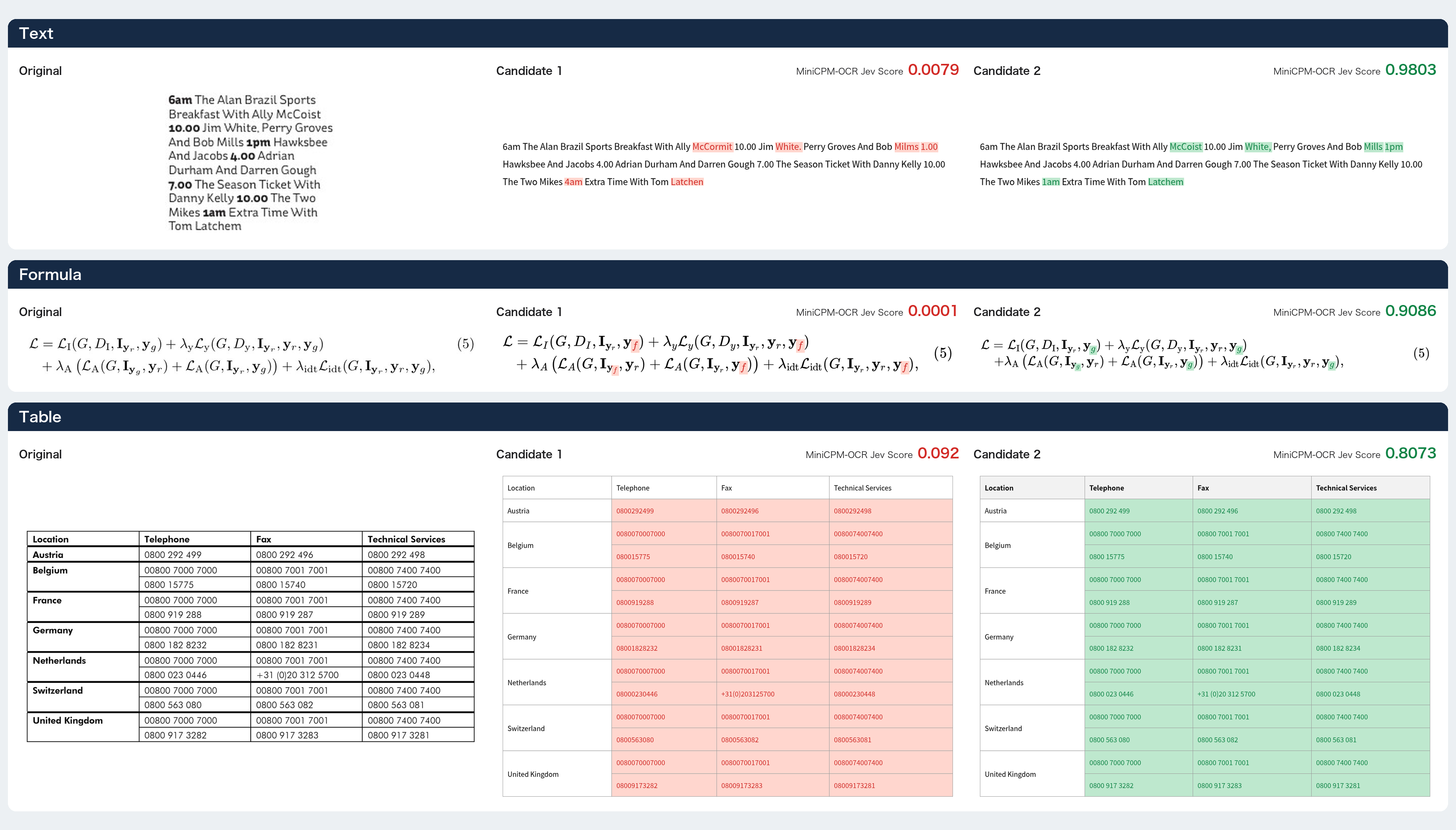
### Examples

The figure below compares the original image with candidates 1 and 2, showing how MiniCPM-OCR
Jev scores text, formula, and table candidates.

<p align="center"><img src="https://raw.githubusercontent.com/OpenBMB/MiniCPM-OCR/main/assets/minicpm-ocr/jev-case-en.png" alt="Three examples for text, formulas, and tables: original, candidate 1 and candidate 2, with MiniCPM-OCR Jev scores." width="100%"></p>

## Quick start

| Deployment | Guide |
| :--- | :--- |
| Cloud API | [Single-candidate scoring, best-of-N, batched best-of-N](https://github.com/OpenBMB/MiniCPM-OCR/blob/main/docs/minicpm_ocr_jev_api_en.md) (stub — being written) |
| Docker / local SDK | [Environment, rendering options, service startup](https://github.com/OpenBMB/MiniCPM-OCR/blob/main/docs/minicpm_ocr_jev_tutorial_en.md) |
| vLLM backend | [Service configuration with and without a renderer](https://github.com/OpenBMB/MiniCPM-OCR/blob/main/docs/vllm_deploy_jev_en.md) |
| SGLang | [Deployment guide](https://github.com/OpenBMB/MiniCPM-OCR/blob/main/docs/sglang_deploy_jev_en.md) |
| llama.cpp | [GGUF deployment guide](https://github.com/OpenBMB/MiniCPM-OCR/blob/main/docs/llamacpp_deploy_jev_en.md) |
| Ollama | [Deployment guide](https://github.com/OpenBMB/MiniCPM-OCR/blob/main/docs/ollama_deploy_jev_en.md) |
| FlagOS (multi-chip) | [Deployment guide](https://github.com/OpenBMB/MiniCPM-OCR/blob/main/docs/flagos_deploy_en.md) |

When a service has a built-in renderer (cloud API, Docker, SDK), check `verdict` before using
the score — only `scored` means model scoring actually ran. Fixed values returned for precheck,
rendering, or forward-pass failures must not be read as low model scores.


### Fine-tuning

[ms-swift guide](https://github.com/OpenBMB/MiniCPM-OCR/blob/main/docs/finetune_jev_en.md): data format, binary classification head
configuration, training commands, and JevOCRBench evaluation.

## Related checkpoints

| Format | Hugging Face | ModelScope |
| :--- | :--- | :--- |
| BF16 (original) **(this repo)** | [🤗](https://huggingface.co/openbmb/MiniCPM-OCR-Jev) | [ModelScope](https://modelscope.cn/models/OpenBMB/MiniCPM-OCR-Jev) |
| GGUF (llama.cpp) | [🤗](https://huggingface.co/openbmb/MiniCPM-OCR-Jev-gguf) | [ModelScope](https://modelscope.cn/models/OpenBMB/MiniCPM-OCR-Jev-gguf) |
| AWQ W4A16 | [🤗](https://huggingface.co/openbmb/MiniCPM-OCR-Jev-AWQ) | [ModelScope](https://modelscope.cn/models/OpenBMB/MiniCPM-OCR-Jev-AWQ) |
| GPTQ W4A16 | [🤗](https://huggingface.co/openbmb/MiniCPM-OCR-Jev-GPTQ) | [ModelScope](https://modelscope.cn/models/OpenBMB/MiniCPM-OCR-Jev-GPTQ) |

Jev works on candidates from any parser. The companion parser is
[MiniCPM-OCR 1.0](https://huggingface.co/openbmb/MiniCPM-OCR-1.0).

## FAQ

Installation, model downloads, GPU memory, input formats, and unexpected outputs:
[FAQ](https://github.com/OpenBMB/MiniCPM-OCR/blob/main/docs/faq_en.md).

## License

Model weights, code, and documentation are released under the
[Apache License 2.0](https://github.com/OpenBMB/MiniCPM-OCR/blob/main/LICENSE).