---
title: inspatio-world-v1.5
canonical_url: "https://www.modelscope.ai/models/InSpatio/inspatio-world-v1.5"
md_url: "https://www.modelscope.ai/models/InSpatio/inspatio-world-v1.5.md"
repository: InSpatio/inspatio-world-v1.5
last_updated: 2026-09-30
pipeline_tag: any-to-any
tasks:
- any-to-any
parameters: 1.4B
tensor_type:
- F32
library_name:
- safetensors
downloads: 8
stars: 0
---
# inspatio-world-v1.5
> inspatio-world-v1.5 - An open-source model by InSpatio on ModelScope. 🤖 ModelScope | 🤗 HuggingFace | 💻 GitHub | 🌐 Project Page | 📑 Paper |…
- **Repository**: InSpatio/inspatio-world-v1.5
- **Tasks**: any-to-any
- **Parameters**: 1.4B
- **Downloads**: 8
- **Stars**: 0
- **Last updated**: 2026-09-30
Source: https://www.modelscope.ai/models/InSpatio/inspatio-world-v1.5
---
InSpatio-World-1.5
🤖 ModelScope |
🤗 HuggingFace |
💻 GitHub |
🌐 Project Page |
📑 Paper |
🖥️ Live Demo
## Introduction
**InSpatio-World** is a real-time 4D world simulator via spatiotemporal autoregressive modeling. This repository provides the **InSpatio-World-1.5 1.3B checkpoint**.
- **Multiple input modes** — Run inference from a single image, four images, or a video.
- **Target camera trajectories** — Supply a target camera trajectory to generate video from the requested viewpoints.
- **Depth and source camera estimation** — For video inputs, Depth Anything 3 estimates missing depth and per-frame source camera intrinsics and extrinsics.
- **Real-time examples** — See the single-image and multi-image inference results in the showcase below.
For more details, see the [GitHub repo](https://github.com/inspatio/inspatio-world-v1.5), [project page](https://inspatio.github.io/inspatio-world-v1.5/), and [paper](https://arxiv.org/abs/2604.07209).
## Quick Start
### Installation
Requirements: **Python 3.10** and **CUDA 12.6**.
```bash
git clone https://github.com/inspatio/inspatio-world-v1.5.git
cd inspatio-world-v1.5
conda env create -f environment.yml
conda activate inspatio_world_test
python -m pip install --no-deps depth-anything-3==0.1.1
python -m pip install modelscope
```
The official `environment.yml` includes the packages DA3 uses on this inference path. Installing DA3 separately with `--no-deps` avoids installing its unrelated app and benchmark dependencies. On Hopper GPUs, the official repository recommends FlashAttention-3 (FA3) for faster attention.
### Run the Demo
```bash
bash run_example.sh
```
This runs the six scenes listed in `examples/manifest.json`. Results are saved to:
```text
output//
├── source.mp4
├── render.mp4
├── mask.mp4
└── pred.mp4
```
Image and multi-image scenes reuse uint16 depth PNGs. For video inputs, DA3 estimates missing depth and per-frame source camera intrinsics and extrinsics. The target trajectory is supplied by the user. The default depth mode is `auto`; use `--depth_mode existing` to require existing depth, or `--depth_mode estimate` to regenerate it.
### Single-Image and Multi-Image Inputs
Prepare a scene using the official [image and multi-image examples](https://github.com/inspatio/inspatio-world-v1.5/blob/main/examples/README.md), then run:
```bash
bash run_inference.sh --scene_dir /path/to/my_scene
```
Inputs must be **832×480**. A scene includes RGB input, depth maps, a prompt, source camera intrinsics and poses, a target camera trajectory, and scene metadata. See the linked examples for the file layout and camera matrix conventions.
### Video Inputs
Provide the RGB video, prompt text, and one target OpenCV world-to-camera **4×4 matrix per frame** (16 row-major numbers per line):
```bash
bash run_inference.sh --video /path/to/input.mp4 \
--prompt "Your prompt" --target_traj /path/to/target_tcw.txt
```
The runner reads the video's frame rate and frame count, resizes it to **832×480** if needed, and estimates depth and per-frame source cameras with DA3. The target trajectory must use the same first-frame-normalized coordinate system and displacement scale as the estimated source cameras.
## Showcase

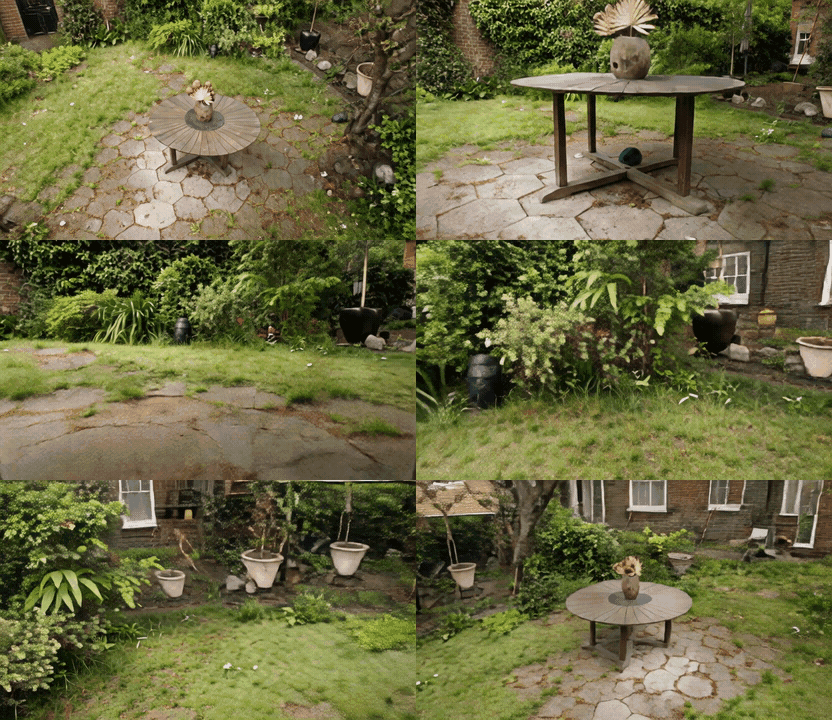
Real-time inference results: single-image input (left) and four-image input (right).
Try the [live demo](https://world.inspatio.com/) for an interactive experience.
## License
The official repository's code is licensed under the [Apache-2.0 License](https://github.com/inspatio/inspatio-world-v1.5/blob/main/LICENSE). The upstream README states that this license applies only to code in its library; dependencies such as [Depth Anything 3](https://github.com/ByteDance-Seed/depth-anything-3) are separately licensed.
## Citation
If you use InSpatio-World in your research, please use the BibTeX entry provided by the official repository:
```bibtex
@misc{inspatio-world,
title={INSPATIO-WORLD: A Real-Time 4D World Simulator via Spatiotemporal Autoregressive Modeling},
author={InSpatio Team},
journal={arXiv preprint arXiv: 2604.07209},
year={2026}
}
```
## Acknowledgement
InSpatio-World uses a backbone based on [Wan2.1](https://github.com/Wan-Video/Wan2.1), with its training code referencing [Self-Forcing](https://github.com/guandeh17/Self-Forcing). We thank the Self-Forcing and Wan teams for their work and open-source contributions, and acknowledge [Depth Anything 3](https://github.com/ByteDance-Seed/depth-anything-3) and [ReCamMaster](https://github.com/KlingAIResearch/ReCamMaster) for their contributions.